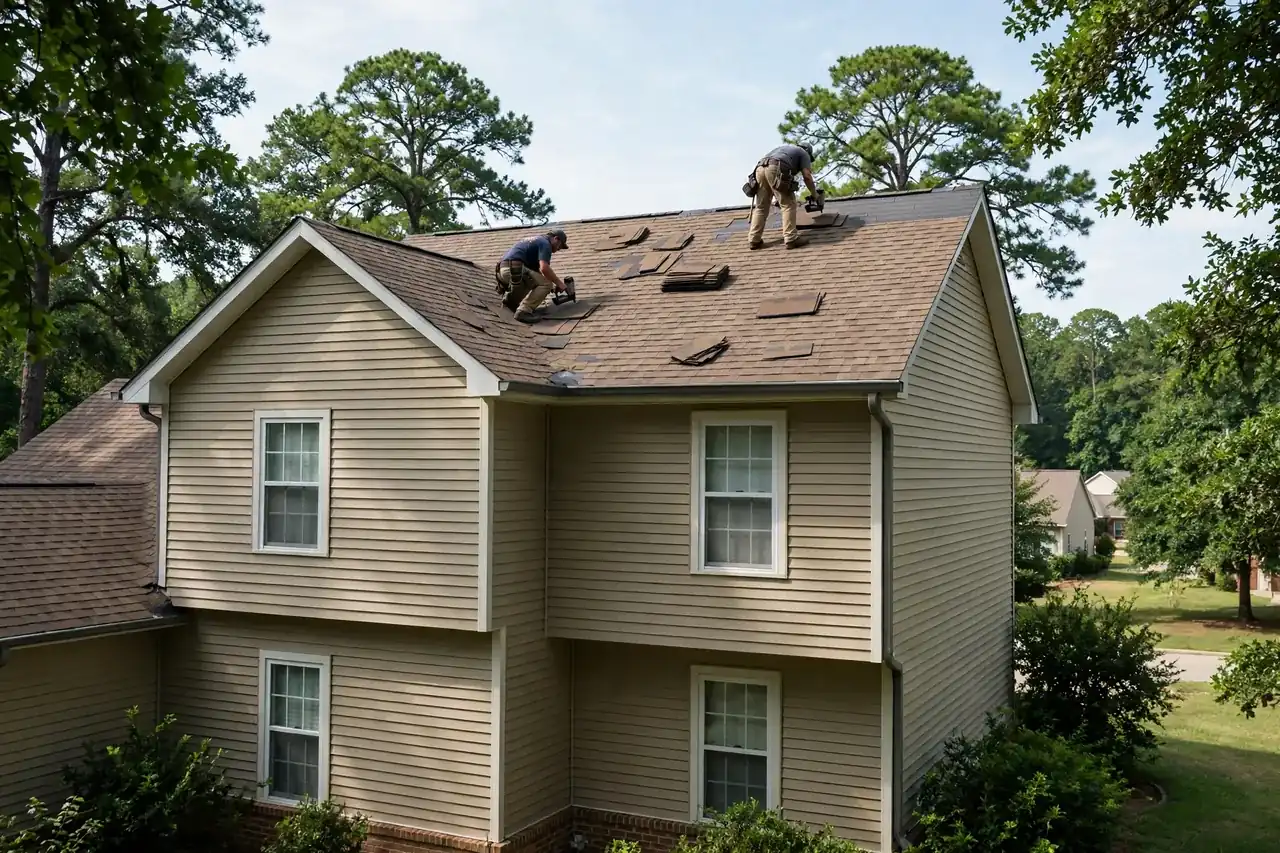
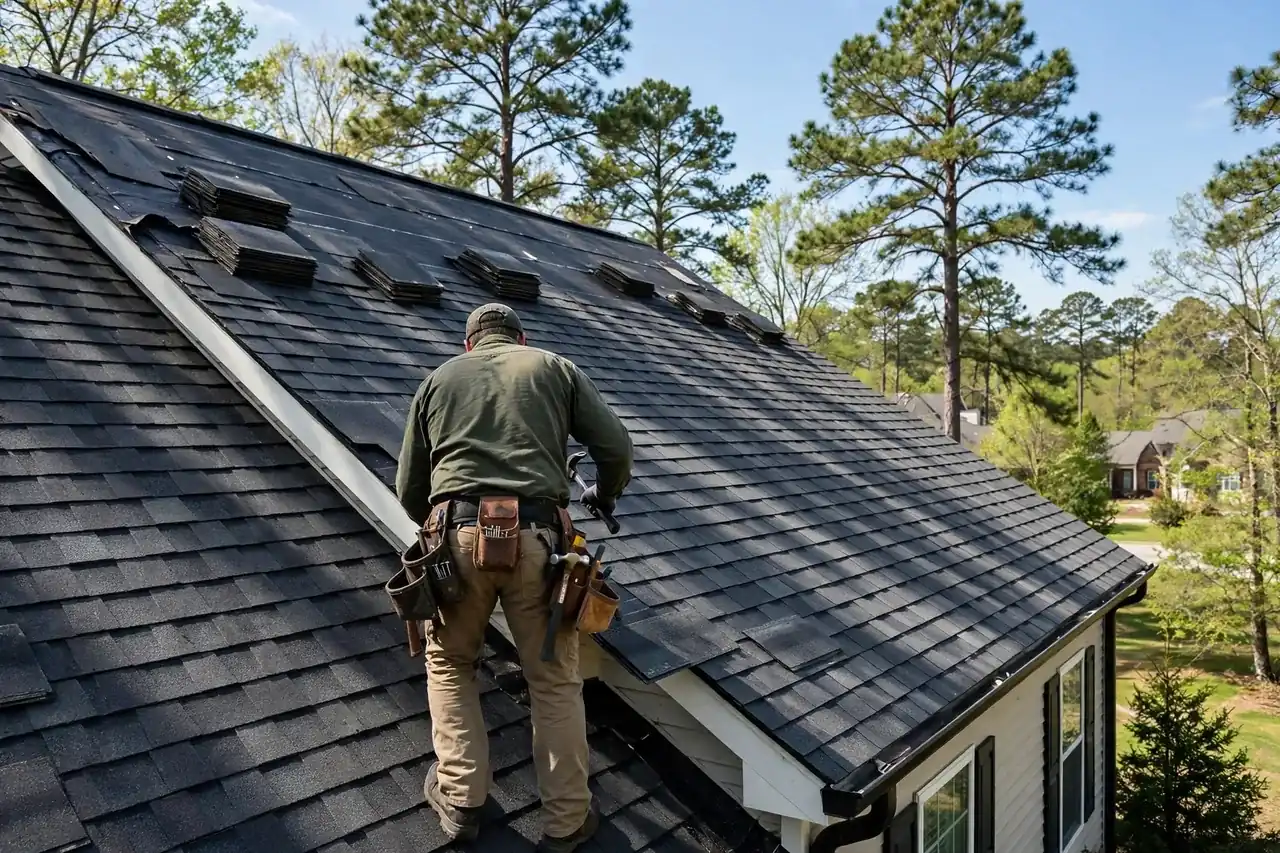
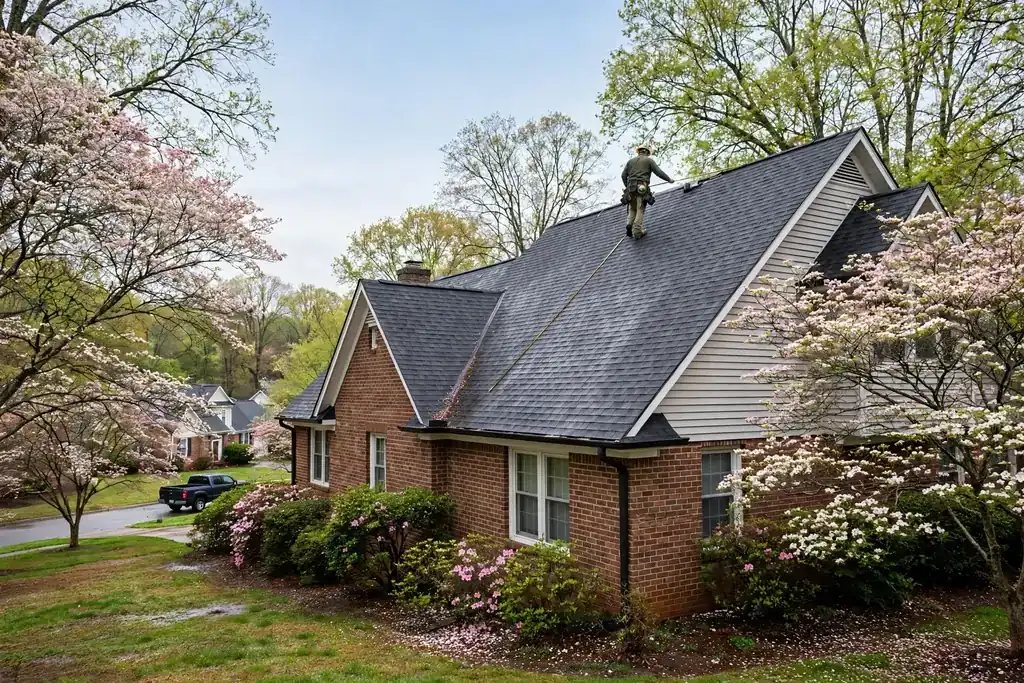
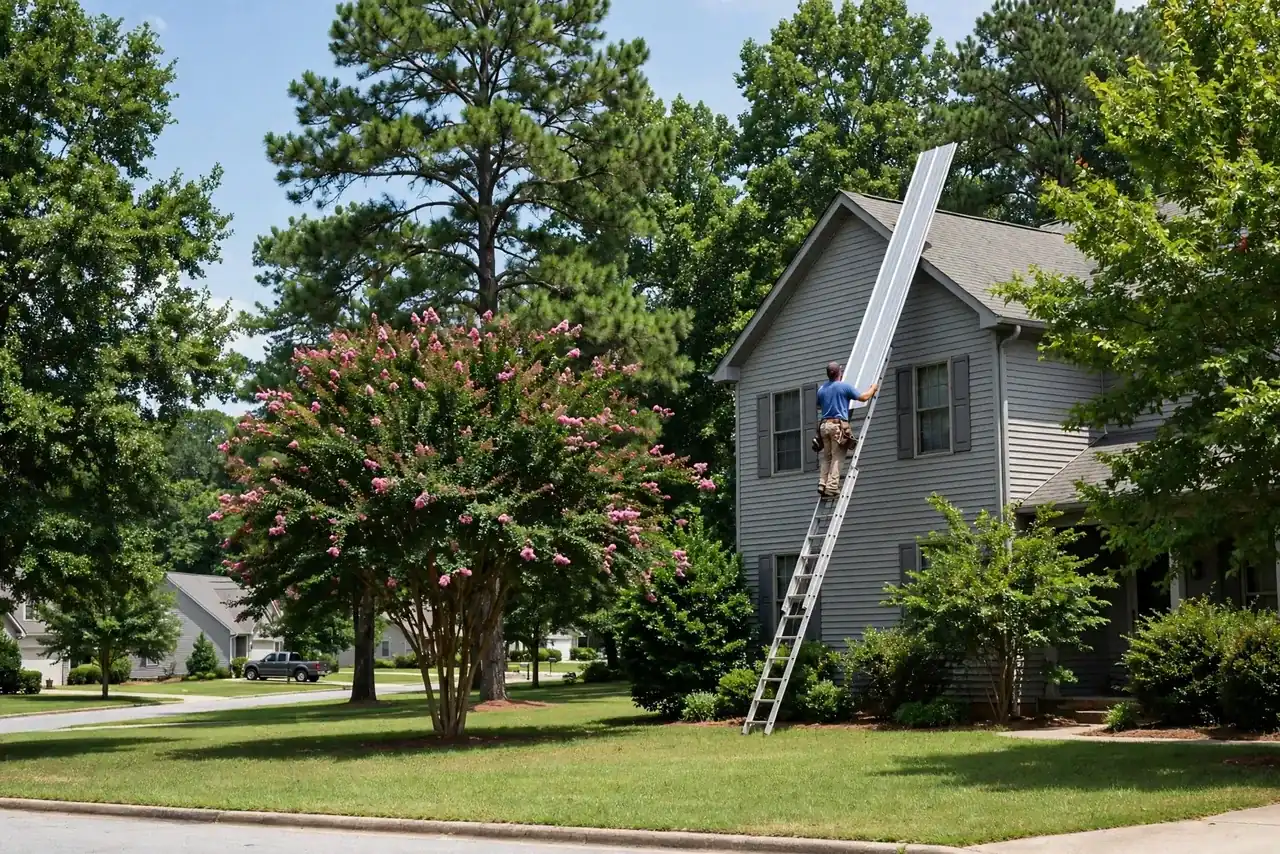
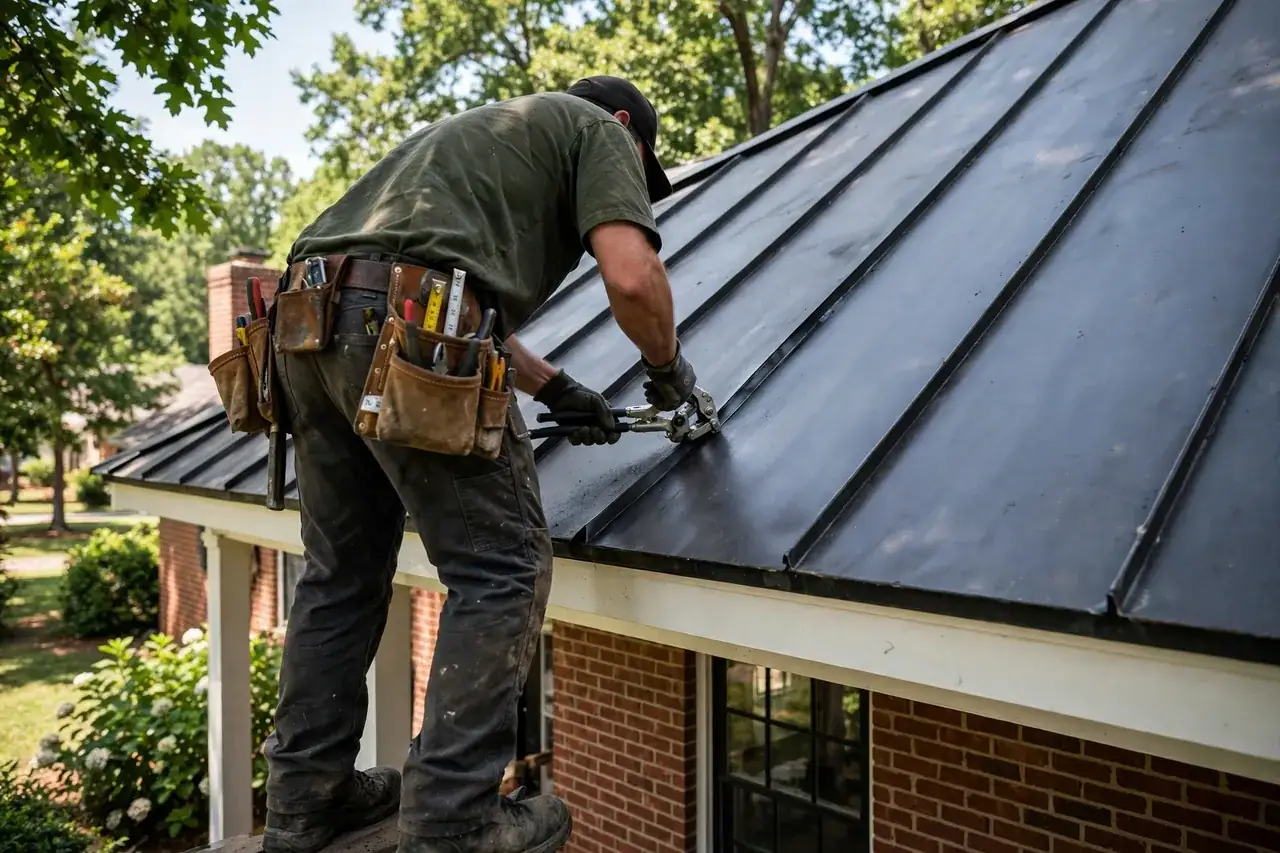
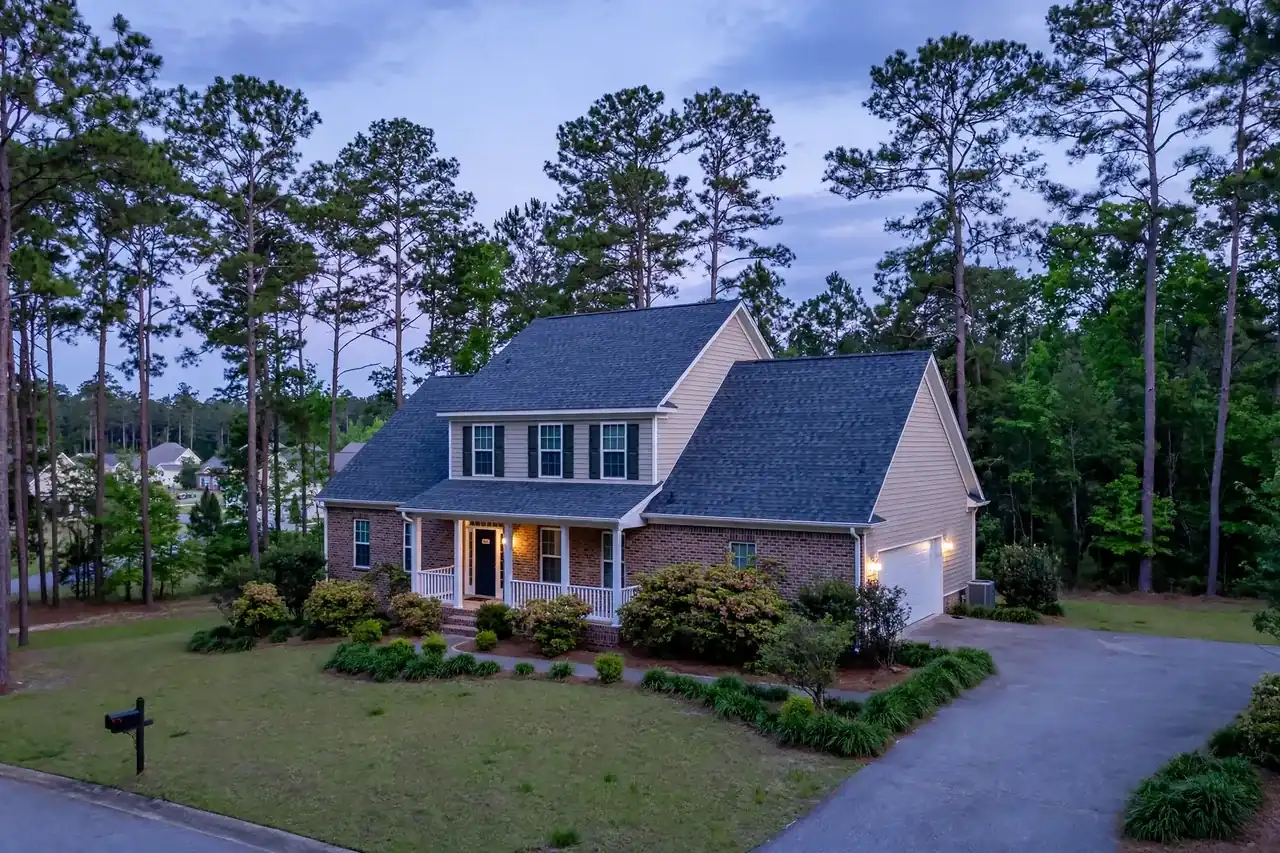
For flat roof repair Douglasville GA, Finnegan Services LLC repairs and installs flat and low-slope roofs. On a low-slope roof, ponding and drainage matter more than membrane brand: tapered insulation, crickets, drains and flashing details decide whether summer downpours clear or sit. Georgia issues no state roofing licence (O.C.G.A. § 43-41-17 exemption); a state contractor licence is required only over $2,500 or beyond the roofing specialty. See what to check before hiring a roofer.
A flat-roof scope covers inspection, membrane, insulation, flashing and drainage, with anything beyond it priced separately.
Full Roof Inspection
A full roof inspection with moisture scan, checking membrane, seams, flashing, drains and deck condition, so ponding and wet insulation are found before they are covered.
Membrane Installation
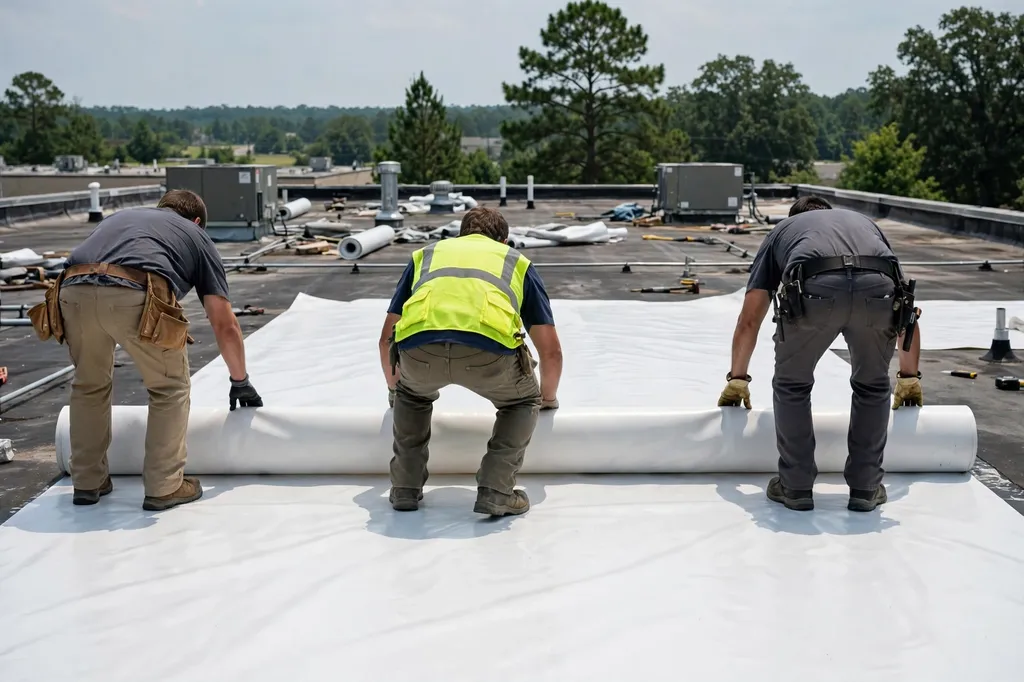
Membrane installation in the specified system, TPO, EPDM or modified bitumen, with seams, laps and fastening set by the adopted code and the manufacturer's instructions for the address.
Insulation Replacement
Insulation replacement where wet or compressed insulation is found, with tapered insulation and crickets where drainage needs correcting, because ponding is a drainage problem first and a membrane problem second.
Flashing and Penetration Work
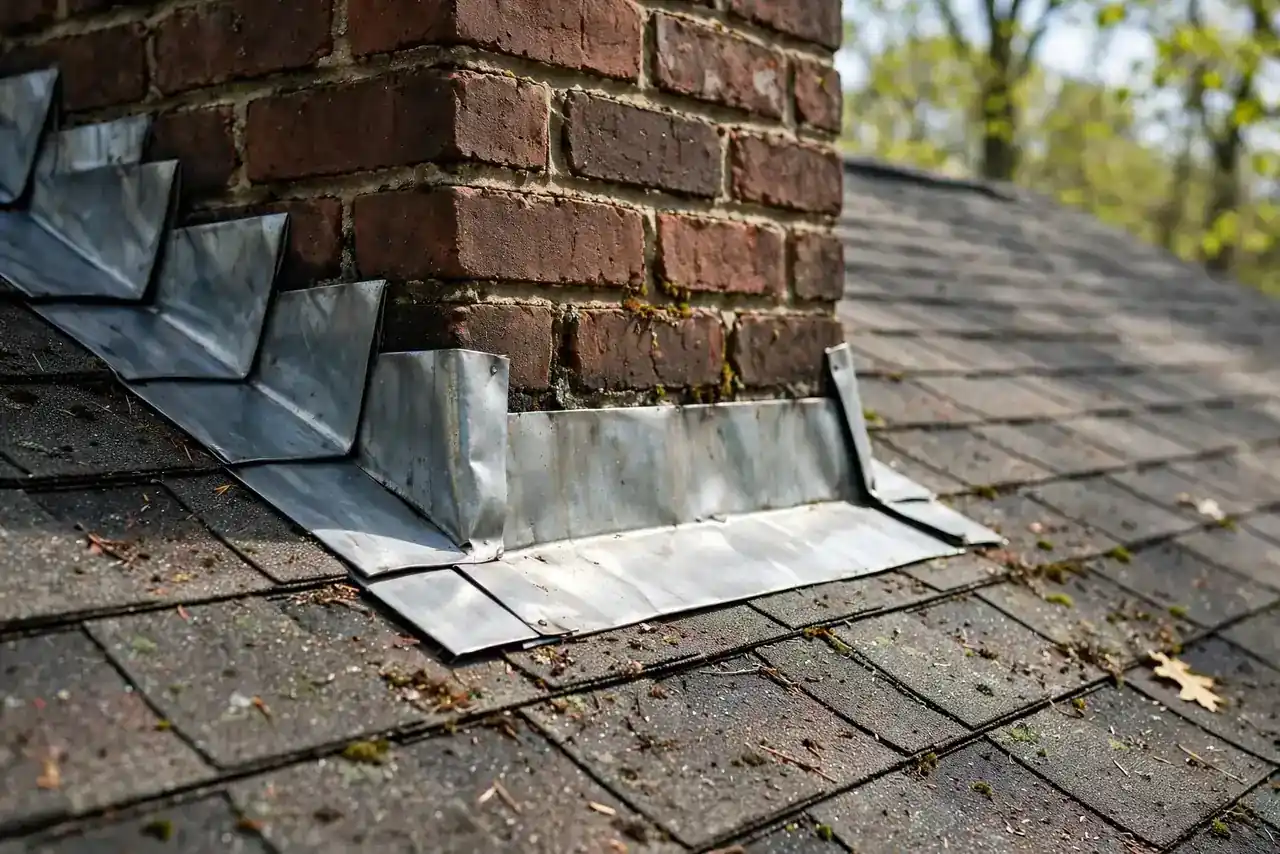
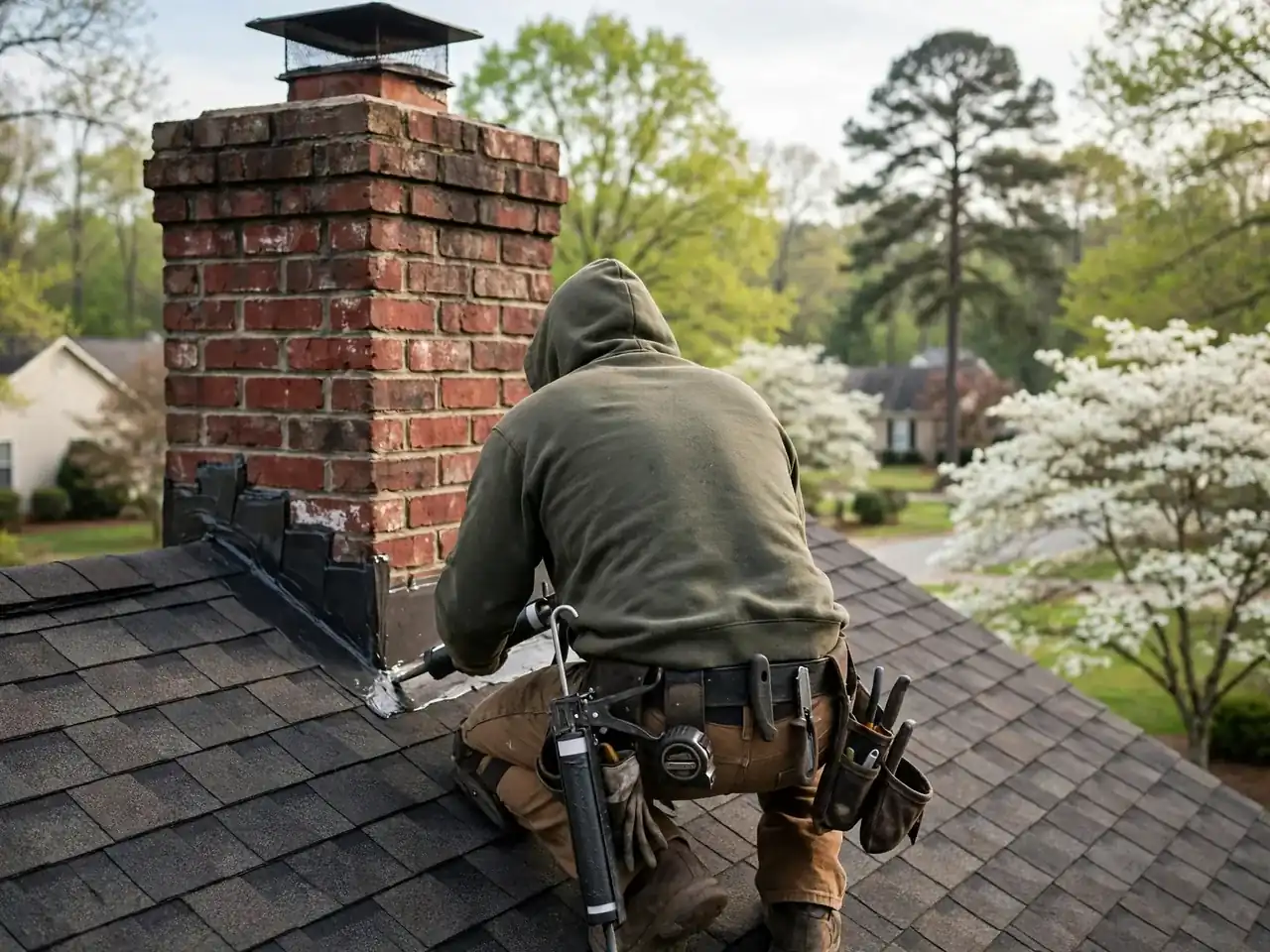
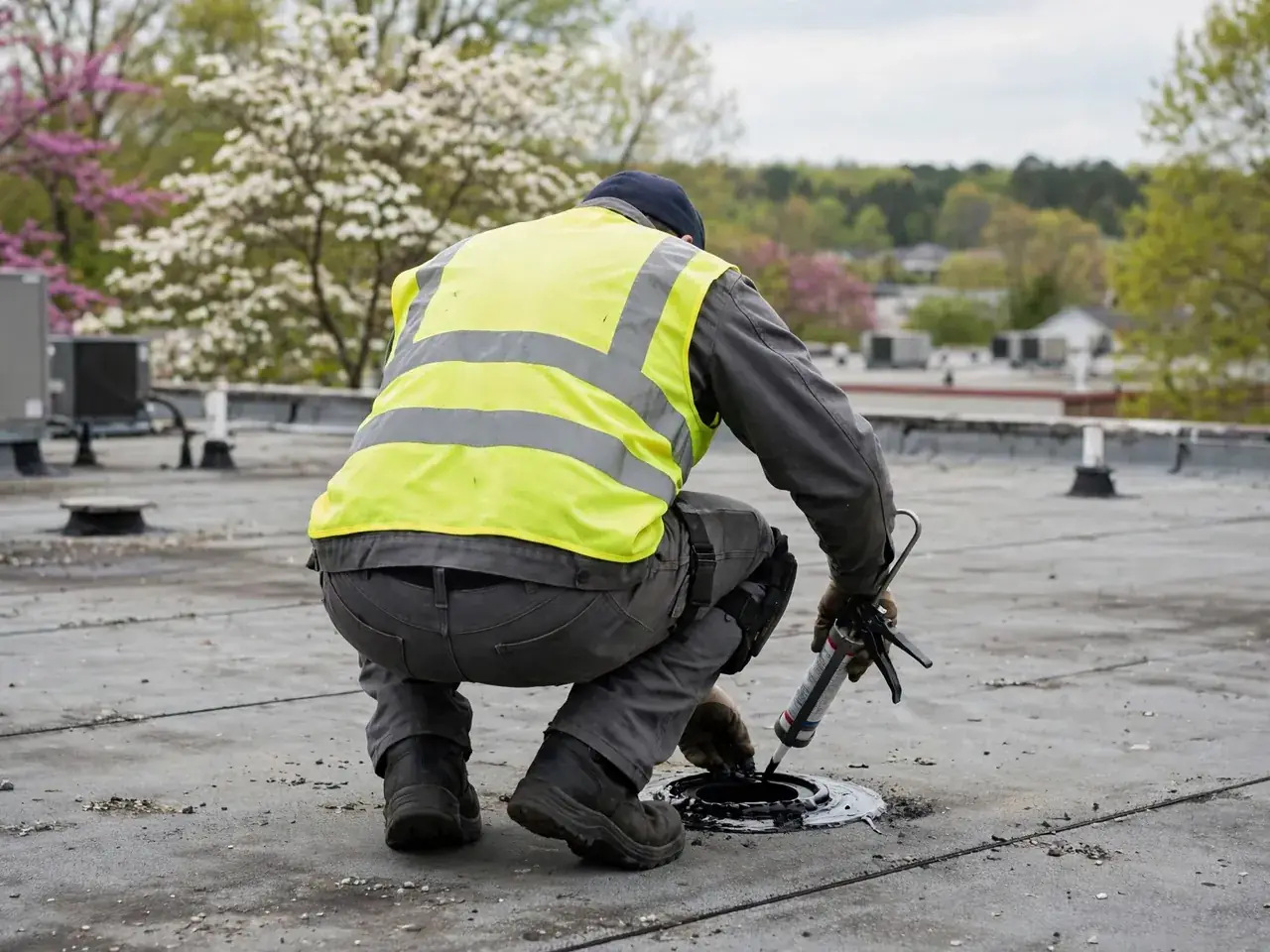
Flashing and penetration work at curbs, vents, drains, walls and rooftop gear, with new metal and seals where old flashing has failed, and self-adhered membrane at penetrations only as an optional upgrade, never as code.
Drain and Gutter Clearing
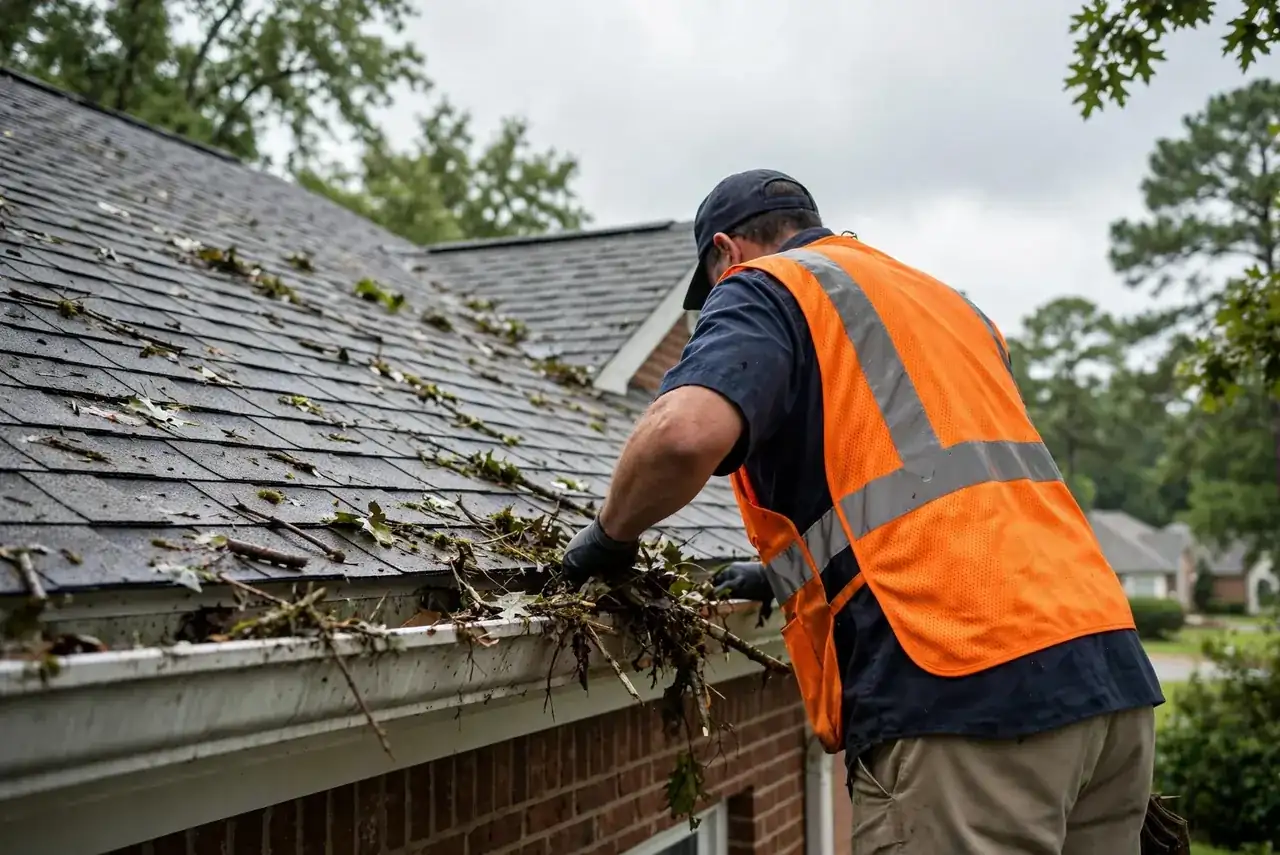
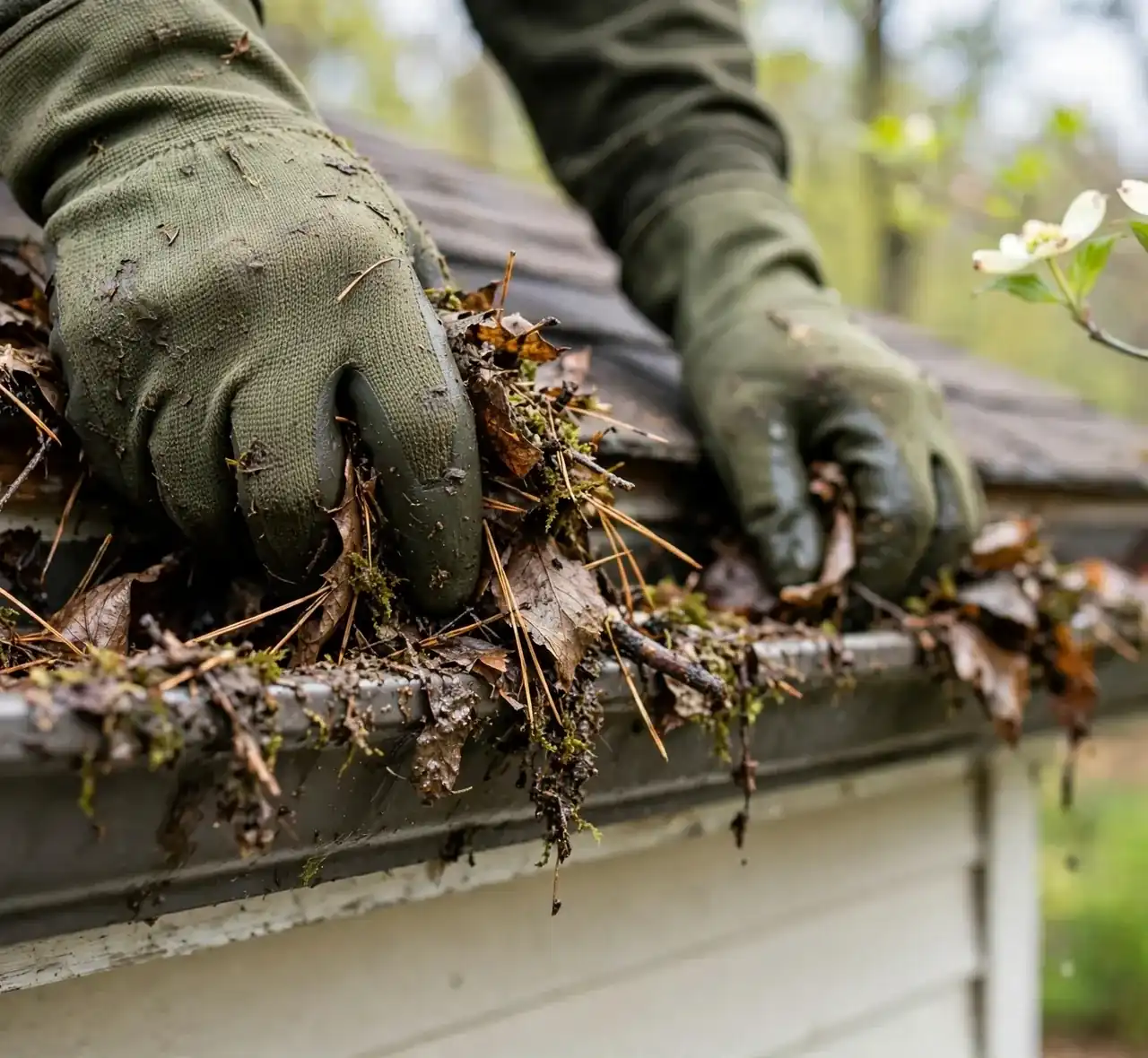
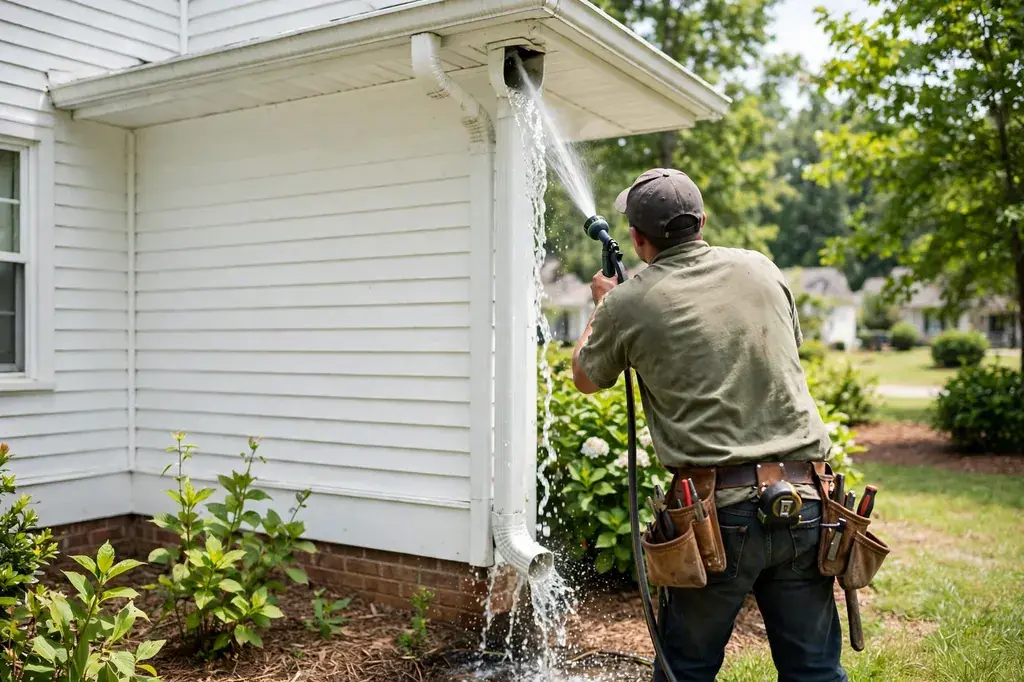
Drain and gutter clearing, so drains, scuppers and gutters flow after the job, not just during the water test.
Water Testing and Walkthrough
Water testing and walkthrough, with a photo log of the membrane, seams, flashing and drainage details, and a written scope of what was replaced and what was left to monitor.
Homes and businesses.
The approach is the same for a home and a business; access, schedule and paperwork are what change.
For Homes
For homes, flat work covers porches, additions and low-slope sections, with drainage, flashing and penetration details scoped first, and a photo file that a homeowner or landlord can keep.
Porch roof leaking at wall
Garage roof ponding after rain
Ceiling stain spreading from flat section
For Businesses
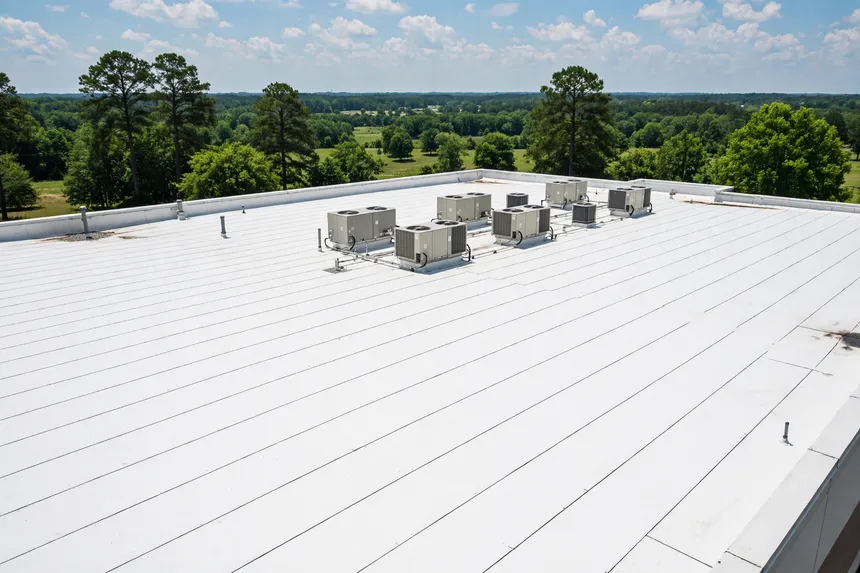
For businesses, flat work covers the full low-slope roof, with insulation, membrane, drainage and rooftop-gear penetrations planned together, and work scheduled around operations.
Active leak over inventory
Storm damage before insurance window
Aging membrane nearing replacement
What Flat Roofing in Douglasville Actually Involves
TPO, EPDM and the drainage details that decide a flat roof's life.
Flat roofing in Douglasville, GA covers TPO, EPDM and modified-bitumen systems on low-slope homes, porches, additions and commercial buildings, with ponding, flashing and ventilation as the recurring problems in local roofer content. TPO is the reflective, mid-price option, EPDM the budget option, and modified bitumen the durable, labour-intensive option, and the scope keeps those three distinct, with membrane, insulation, drainage and penetration details recorded, because a membrane choice without a drainage plan is not a scope.
Douglasville's flood-adjacent water story is roof-adjacent, not roof-caused: the 21 September 2009 flood, with over 18 inches overnight, hit Douglasville, Villa Rica, Austell, Lithia Springs and Chapel Hill hardest, and floodplain-adjacent homes along Dog River, Sweetwater Creek and Anneewakee Creek corridors need roof-to-interior water-path checks, not a claim that any named subdivision is in a flood zone. Related services: commercial roofing, roof maintenance, roof inspection. Local pages: Downtown Douglasville and Lithia Springs.
A flat roof is only as good as its seams, flashing, and drains.
What it is
A low-slope roof waterproofed with continuous membrane instead of overlapping shingles.
When you need it
When a flat roof leaks, ponds, ages out, or needs a coating to extend its life.
What to expect
A moisture scan, itemized pricing, membrane installation, and a water test before we leave.
How Our Flat Roofing Process Works
How a flat-roof job runs, from scan to water test.
Inspection and Moisture Scan
Inspection and moisture scan maps wet insulation, ponding, seam and flashing failure, and drainage blockage, with photos, before any membrane is specified.
Walk the roof
Scan for moisture
Photograph problems
Written Scope and Pricing
A written scope and pricing records the membrane system, insulation, drainage corrections and penetration work, priced by measured roof area, not by a flat rate.
Itemized scope
Membrane options
Flashing details
Tear-Off or Prep
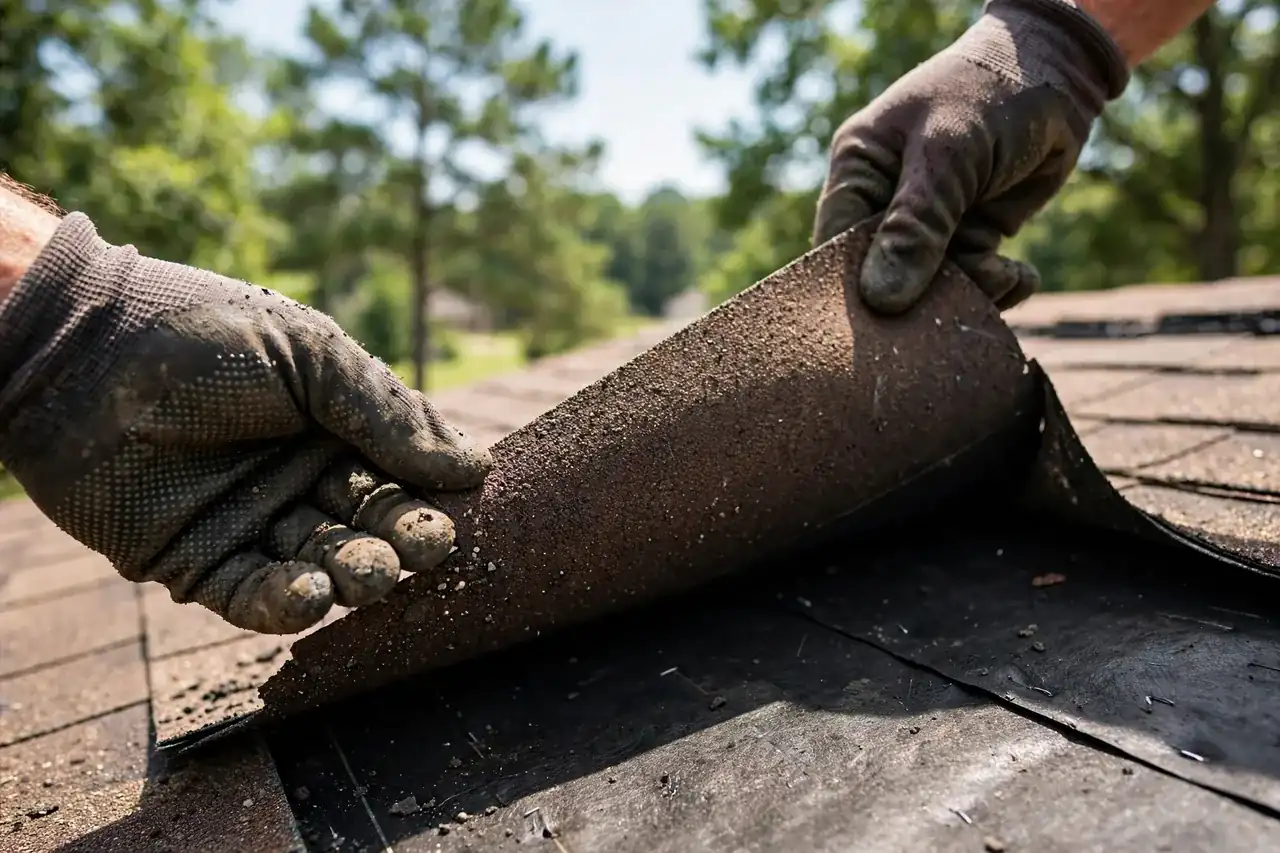
Tear-off or prep removes failed membrane and wet insulation where found, and prepares the deck and drainage plane for the new system.
Tear off
Replace wet decking
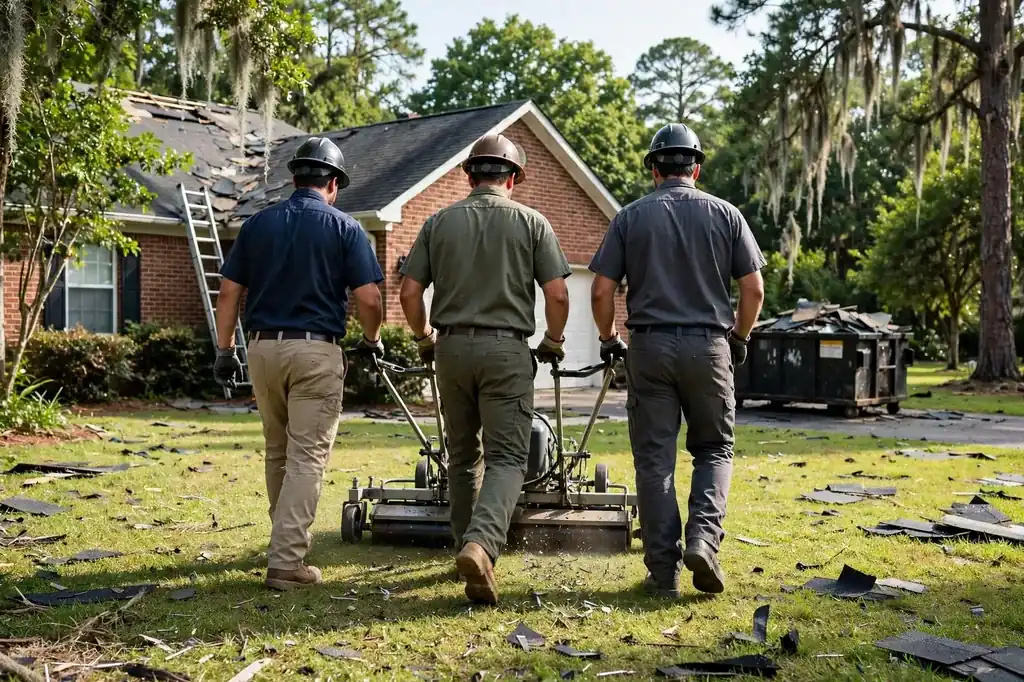
Haul debris
Membrane Installation
Membrane installation lays insulation, membrane, seams and flashing in sequence, with drainage details, crickets and tapered insulation where the scope calls for them.
Install insulation
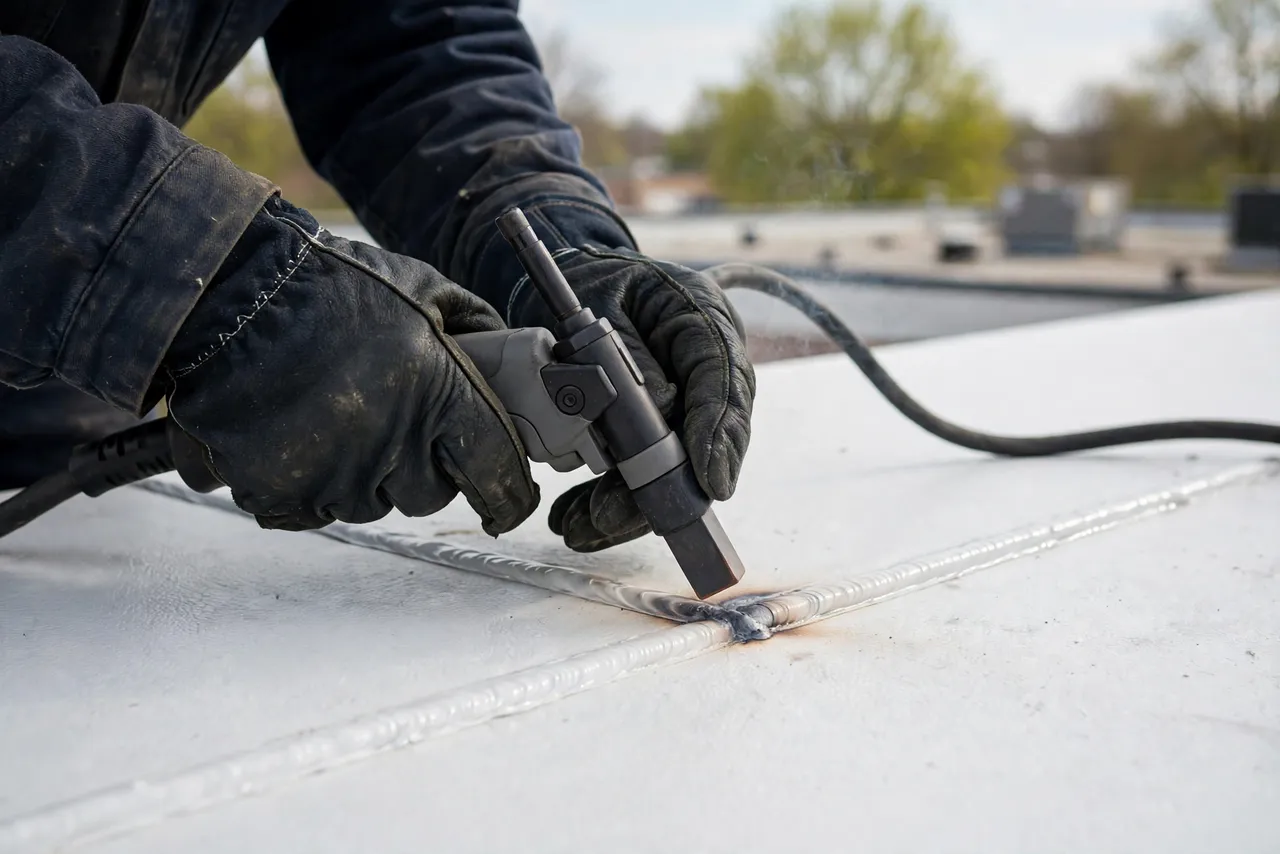
Weld membrane
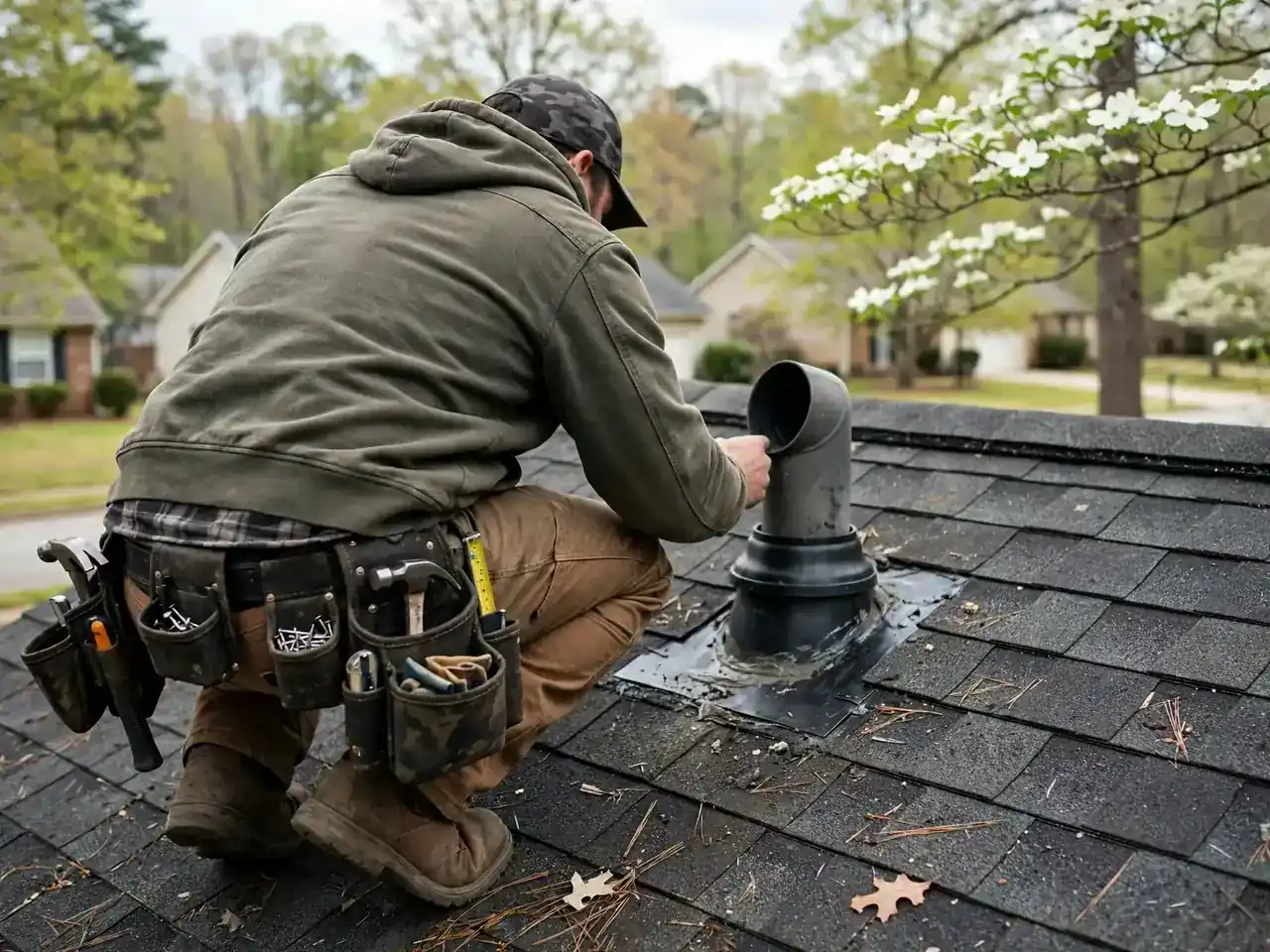
Flash penetrations
Water Test and Walkthrough
Water test and walkthrough checks drains, seams and penetrations, clears gutters, hauls debris, and walks the roof against the written scope and photo log.
Flood test
Interior check
Walkthrough and photos
Tools and Methods We Use on Flat Roofs
Move across a circle, or focus it and press Enter, for an illustrative thermal view of the photograph.
Infrared Camera
Finds saturated insulation under the membrane by reading surface temperature differences. Wet insulation holds heat differently than dry, so the camera shows us exactly where the moisture is before we cut anything open.
Moisture Meter
Confirms what the infrared camera suggests. We take readings at grid points across the roof to map wet areas and verify that repairs have dried out properly. It is the difference between guessing and knowing.
Heat Welder
Fuses TPO membrane seams into a single continuous sheet. A properly welded seam is stronger than the membrane itself. We test seam strength by hand and with a probe on every job.
Roofing Nail Gun
Fastens cover board, insulation, and membrane termination bars to the deck. We adjust pressure and depth so fasteners seat correctly without over-driving through the board.
Pry Bar and Roofing Hammer
Removes old flashing, termination bars, and edge metal during tear-off and repair. Hand tools give us control around penetrations and edges where a power tool would cause damage.
Thermal views are illustrative, generated from the photographs.
Methods
Chalk Line
Marks straight lines for membrane layout, seam placement, and fastener patterns. Straight seams weld better and look right, and a chalk line keeps the layout consistent across a large roof.
Safety Harness and Roofing Ladder
Keeps our crew safe on the roof edge and during access. We set up fall protection on every job, even on low-slope roofs, and use ladders rated for the load and height.
Infrared Moisture Survey
We scan the roof surface with an infrared camera in the late afternoon when temperature differences are greatest, then confirm findings with a moisture meter. This tells us exactly which insulation is wet and which is dry, so you do not pay to replace material that is fine or leave wet insulation under a new membrane.
Heat-Welded TPO Seams
TPO seams are welded with a hot-air welder at the manufacturer's specified temperature and speed, then tested by probing the seam edge. A properly welded seam is stronger than the membrane itself.
Flood Testing and Hose Testing
After a repair or installation, we flood-test the area or hose-test it to confirm water drains and does not penetrate. We check the interior for moisture at the same time. A roof is not done until we have proven it holds water.
Manufacturer-Spec Installation
We install membrane, insulation, flashing, and termination details to the written spec from current manufacturer lines.
When Douglasville Property Owners Call Us
Aging TPO commercial
A commercial building near Arbor Place has a TPO roof that is 18 years old and starting to show seam separation and small tears around HVAC curbs.
We inspect the full roof, moisture-scan the insulation, and repair the failed seams and curb flashing. If the membrane is still sound overall, we recommend a reflective coating to extend its life rather than a full replacement. If the scan shows widespread saturation, we price a partial or full replacement.
Outcome: You get a watertight roof for a fraction of replacement cost, or a clear recommendation if replacement is the better call. Either way, you know why.
Porch roof leak
A homeowner in Chapel Hill has a flat roof over a back porch that leaks into the ceiling every time it rains hard.
We inspect the porch roof, find the failed flashing at the wall transition, and repair it with reinforced membrane and new termination. We also check the drains and clear any debris. Most porch roof leaks are flashing failures, not membrane failures.
Outcome: The leak stops, the ceiling stain stops spreading, and you avoid replacing a roof that still has years left in it.
Storm damage response
A property manager at a building on Highway 5 has an active leak after a storm and needs it stopped before the weekend.
We respond with emergency tarping and temporary sealing to stop the water. Once the immediate leak is controlled, we schedule the permanent repair and document the damage with photos and moisture readings for the insurance claim.
Outcome: The leak is controlled promptly during business hours, your tenant or inventory is protected, and the permanent repair is scheduled with documentation in hand.
Coating over bitumen
A building owner near Downtown Douglasville has an older modified bitumen roof that is nearing the end of its life but is not leaking yet.
We inspect the surface, check for blisters and open seams, and moisture-scan the insulation. If the roof is sound, we clean, patch, and prime it, then apply a reflective coating that adds 10 to local experience life.
Outcome: You defer a full replacement for over a decade, lower your cooling costs with a reflective surface, and get a documented record of the roof's condition.
Solar panel prep
A homeowner in Stewart Mill is adding solar panels and needs to know if the flat roof section can handle the mounting hardware.
We inspect the membrane and deck, confirm the structure can take the load, and plan the penetration layout so the solar mounts do not compromise the waterproofing. We install walkway pads and flash any new penetrations.
Downtown DouglasvilleChapel HillArbor Place
How Flat Roofing Works in Douglasville
Flat-roof failures in Douglasville most often show as ponding, seam and flashing failure at penetrations, and drainage blockage, especially where tree debris loads drains and gutters. The scope therefore starts with a moisture scan and a drainage check, before membrane is discussed, and any coating is scoped only for a sound roof, not as a repair for a failed membrane.
Permit requirements differ between City of Douglasville addresses and unincorporated Douglas County addresses, and are confirmed for your parcel before quoting; no permit fee or definitive trigger is published here. An ice barrier is not code-required in Douglasville: the IRC trigger is a January mean of 25°F or below, and Douglasville's January mean is about 42°F, so self-adhered membrane in valleys and at penetrations is offered only as an optional system upgrade, never as code. Georgia issues no state roofing licence (O.C.G.A. § 43-41-17 exemption); a state contractor licence is required only over $2,500 or beyond the roofing specialty. See what to check before hiring a roofer.
If you are looking for flat roofing companies in Douglasville GA, look for one that scans for moisture before quoting and installs to manufacturer spec. We do both. Most of our flat roof repair Douglasville GA work starts with a moisture scan, because guessing at what is wet costs you money either way.
Downtown Douglasville: Older commercial buildings with modified bitumen roofs that respond well to cleaning, patching, and reflective coating. Many are due for coating rather than replacement.
Chapel Hill: Mix of residential additions and small commercial buildings. Porch and carport flat roofs here commonly leak at the wall flashing transition.
Arbor Place: Newer retail and commercial construction, mostly TPO membrane. Seam separation and curb flashing around HVAC units are the most common repair calls.
Highway 5: Commercial and industrial buildings with large flat roofs. Wind damage to edge metal and termination bars is common after storms.
Stewart Mill: Residential area with flat roof sections over garages and additions. EPDM and rolled roofing are common, and most leaks start at drains or wall flashing.
Summer heat expanding membrane and stressing seams: Seams take the most stress from daily expansion and contraction. A seam that is marginal in spring can open by August. We check seam integrity on every inspection and re-weld or splice as needed.
We water-test and walk you through the finished work
From problem to finished result.
IllustrativeThe thermal view is generated from the photograph. It is not a measurement. Drag the handle, or use the arrow keys once it is focused.
TPO Roof Recovered on Highway 5
Before: A 4,000 square foot commercial building had an 18-year-old TPO roof with seam separation along two-thirds of the seams and ponding water near two drains. The insulation was still dry according to our moisture scan, but the seams were failing and the drains were clogged with debris.
After: We cleaned and re-welded the failing seams, cleared and flushed all drains, and installed new pipe boots at four penetrations. We then applied a reflective coating over the sound membrane. The job took three days and cost roughly a third of a full replacement. The roof has held through two storm seasons with no leaks.
Clear drains and gutters twice a year, especially in fall. Check seams each spring for any sign of separation. Keep rooftop HVAC service techs on the walkway pads so they do not damage the coating.
Porch Roof Leak Fixed in Chapel Hill
Before: A homeowner had water staining the ceiling under a flat porch roof every time it rained hard. The membrane itself looked fine, but the wall flashing had pulled away and water was getting behind it. The fascia showed early rot from water running down the edge.
After: We removed the failed flashing, repaired the fascia, and rebuilt the wall termination with reinforced membrane and a new termination bar. We also cleared the porch roof drain, which was partially blocked. The repair took one day. The ceiling stain stopped spreading and the homeowner avoided replacing a roof with years left in it.
Check the wall flashing each spring and fall for any sign of pulling away. Keep the porch drain clear of leaves. If you see a new ceiling stain, call before it spreads.
Storm Damage Repair Near Arbor Place
Before: A windstorm peeled back the edge membrane on a retail building and tore flashing loose at two HVAC curbs. Water was coming into the ceiling tiles during the next rain. The building owner needed it stopped before the weekend.
After: We tarped the roof promptly during business hours to stop the water, then returned once it dried to replace the damaged membrane section, re-terminate the edge with new metal and bars, and rebuild the curb flashing. We documented everything with photos and moisture readings for the insurance claim. The repair took two days after the tarp.
Inspect edge metal and curb flashing after every major storm. Keep the drains clear so water does not back up under the edge. Have the roof inspected annually to catch wind damage before it leaks.
Flat Roof Problems We Fix in Douglasville
Flat roofs fail in predictable ways, and most of those failures start small. Here are the problems we see most often on Douglasville roofs and how we solve them before they turn into ceiling damage and wet insulation.
Ponding waterPonding water that will not drain after a stormStanding water weighs down the membrane, stresses seams, and eventually finds a way through. Left long enough, it saturates the insulation and rots the deck underneath, turning a simple drain clearing into a full replacement. We clear the drains and scuppers, check the roof taper to confirm water is moving toward them, and add a tapered insulation crickets or additional drains where the roof is not pitched correctly. If the membrane has already taken on water, we cut out the saturated section and splice in new membrane with heat-welded seams.
Flashing leaksLeaks at flashing around pipes, walls, and curbsWater gets behind the membrane at a pipe boot or wall termination, travels along the deck, and shows up as a ceiling stain far from the actual leak. Finding it without moisture detection is guesswork. We inspect every penetration, remove failed flashing, and rebuild it with reinforced membrane and proper termination bars. Pipe boots are replaced with prefabricated units sized to the pipe. We water-test the repaired area to confirm the leak is stopped before we leave.
Seam separationSeam separation on TPO and EPDM membraneSeams take the most stress from heat expansion and contraction. When a seam opens, water gets under the membrane and spreads sideways. A small seam failure can soak a large area of insulation before you notice a stain inside. We clean and dry the seam, then re-weld TPO with a heat welder or splice EPDM with proper adhesive and lap sealant. We test the repair with a probe or water test. If multiple seams are failing, we evaluate whether a coating or partial replacement is the better long-term fix.
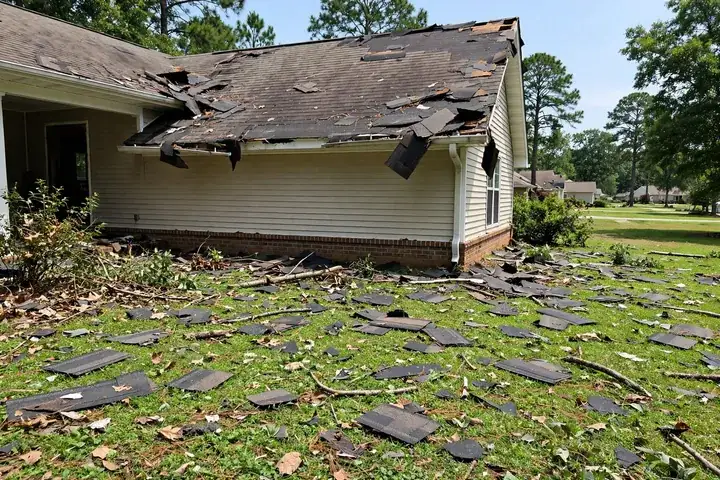
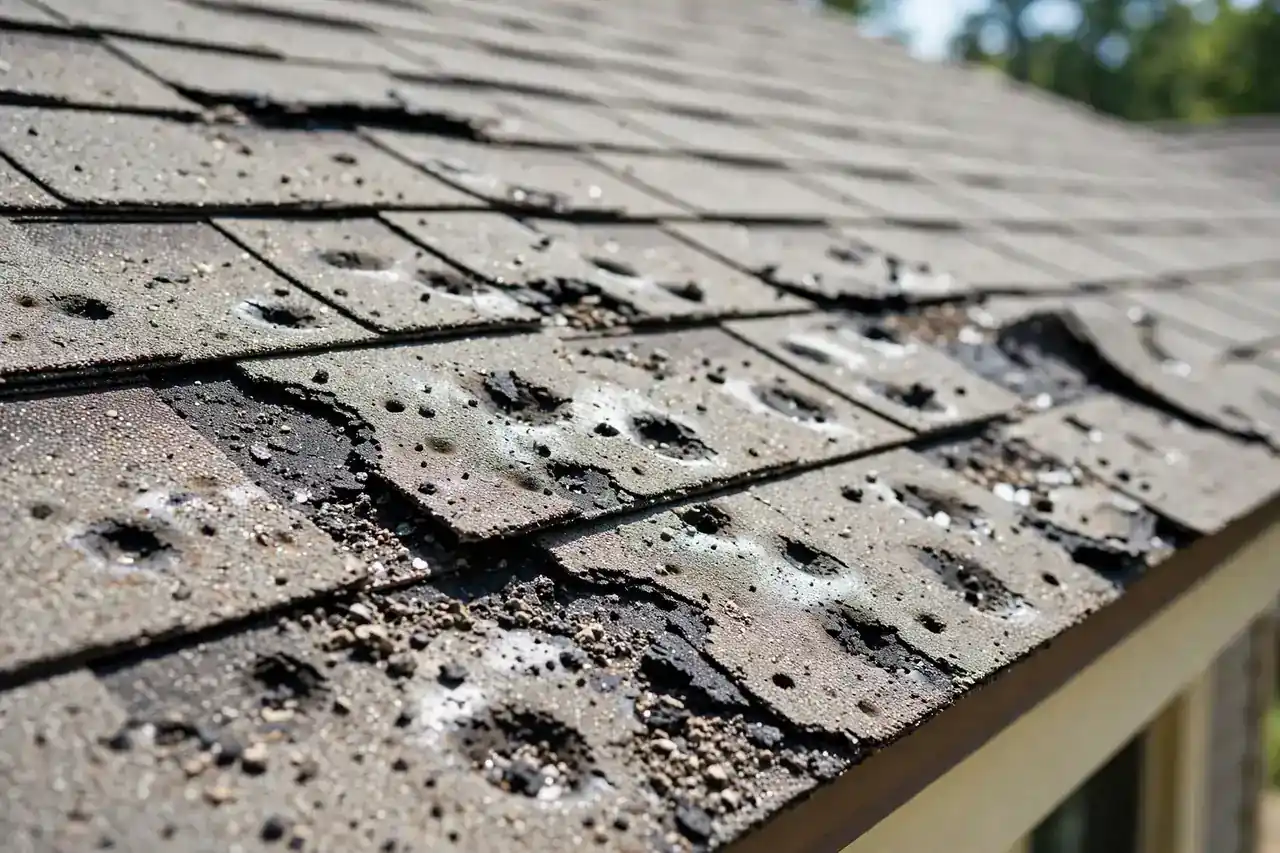
Storm damageStorm damage from wind and hailWind peels back membrane edges and tears flashing loose. Hail bruises the membrane and insulation, and the damage is not always visible from the ground. Both create leaks that show up weeks later, often after the insurance claim window has closed. We inspect after the storm, document damage with photos and moisture readings, and repair or replace as needed. Emergency tarping stops active leaks promptly during business hours. We work with your insurance adjuster and provide the documentation to support the claim.
Clogged drainsClogged gutters and drains backing water under the edgeWhen gutters and drains clog, water backs up under the drip edge and runs down the fascia. That rots the fascia and soffit and can push water into the wall. It is the most preventable flat roof problem there is. We clear gutters, downspouts, and roof drains by hand and flush them to confirm flow. If the fascia or soffit is already damaged, we repair the wood and correct the roof edge detail that let water get behind it. Regular cleaning prevents the problem from coming back.
Why Douglasville Property Owners Choose Flat Systems
A flat roof is a drainage system with a membrane on top, not a membrane alone.
Easy to Inspect and Service
A flat roof can be walked for inspection and rooftop service, and that access makes moisture scans, seam checks and drain clearing practical, provided seams and flashing are not stepped on carelessly. The scope records access and service points, not just the membrane.
Long Service Life With Coatings
Reflective TPO and a sound membrane, with coatings only on a sound roof, are the service-life case for flat systems. No coating is presented as adding a fixed number of years to a failed roof; the scope separates coating from replacement.
Fewer Leaks at Penetrations
Fewer leaks at penetrations come from flashing and curb details, not from membrane choice alone. The scope therefore lists every penetration, curb and drain, with its flashing detail, rather than pricing a membrane by the square foot and hoping the details hold.
Works With Solar and Rooftop Gear
Rooftop gear, solar preparation and HVAC penetrations are planned as part of the scope, with curbs, flashing and drainage coordinated, so a later gear change does not become a leak call.
What you receive
A flat-roof file records drainage first and membrane second.
Drainage and ponding map
Where water sits after rain, and which drains clear it.
Seam and flashing record
Seam welds and flashing detail for the membrane installed.
Membrane spec
TPO, EPDM, or modified-bitumen system as specified for the roof.
Flat roof systems you should know
Not every flat roof is the same. The system on your building determines how it fails and how we fix it.
TPO Membrane
White single-ply, heat-welded seams
Reflects heat
Welded seams
20 to 30 years
EPDM Membrane
Black rubber, spliced seams
Costs less
Absorbs heat
15 to 25 years
Modified Bitumen
Rolled asphalt-based sheets
Common on older buildings
Coating extends life
Shorter service life
Systems and materials we work with
TPO
EPDM
Modified bitumen
Cover board
Rigid insulation
Flashing
Termination bars
Pipe boots
Service ZIP codes.
Flat-roof work runs across 30134 and 30135, including low-slope homes, porches, additions, and commercial buildings in those ZIP codes.
Based in Douglasville and covering the places around it. Pick a local page for neighbourhood detail, including Downtown Douglasville and Lithia Springs.
They were very responsive and answered all my questions while making me feel at ease. I would highly recommend their services.
Frequently Asked Questions About Flat Roofing
As Oct-2026 published market ranges only, not this business's firm prices: TPO $4–$12 per sq ft by measured roof area, with EPDM and modified bitumen in overlapping published bands. Your written scope prices the membrane system, insulation and drainage corrections specified, not a generic flat-roof figure.
Service life depends on membrane, drainage, flashing upkeep and maintenance. A properly installed membrane with drainage corrected and seams maintained is the long-life case, while ponding and unmaintained seams shorten it, so the scope records the drainage and maintenance plan, not just the membrane.
For most Douglasville buildings, white TPO is the common all-around choice because it reflects heat, welds into strong seams and handles ponding water, with EPDM as a budget option on low-traffic roofs. The choice is scoped by traffic, penetrations, drainage and budget, not by a single best-material claim.
Yes, a flat roof can be walked for inspection and service, carefully, with soft-soled shoes, avoiding seams and flashing, and checking drains and penetrations. The scope records access points so service does not become damage.
Other Roofing Services We Provide
Other services from the same team, each written from the same Douglasville research.
Get a Flat Roof Repair Douglasville GA Written Scope
Call Finnegan Services LLC at +1 678-751-2052 for a flat roof scope in Douglasville, GA. The scope follows inspection and moisture scan, priced by measured roof area. Hours: Monday–Friday 8:00 AM–5:00 PM; Saturday–Sunday closed. Finnegan Services LLC, 8635 Park St, Douglasville, GA 30134.
Call us at +1 678-751-2052 or send a message and we will get back to you the same business day. We answer the phone during working hours and return after-hours messages on the next business morning. Storm damage gets priority, so say so when you call.